Posts

Showing posts with the label Discrimination By Design

The CMS Contribution to the Devastation of Rural Health
Image
Searching on CMS and rural health is revealing. There are regular headlines with regard to reports and proposals and programs. The themes of innovation and quality grab the attention. But there has been a continued lack of progress where it matters most - in Rural Health Care and the Ability to Care In the last decade even worse has been the case. The next decade seems to have the potential for devastation to rural health. CMS says rural health needs major improvements in quality,  but CMS leads the nation to pay too little resulting in half enough generalists and general specialists – those who provide 90% of rural services in the places with limitations of quality, outcomes, workforce, and access. Quality and outcomes are actually about the situations, conditions, relationships, and environments as well as income, housing, jobs, education, and other social determinants. CMS contributes to lesser social determinants by designs that send 15% less to rural p...

Innovation Is the Problem Not the Solution for Worsening Health

Image
Innovation is good. Innovation worship is not good. Innovation application without scientific testing or clinical trials is unethical regarding clinical interventions and should be just as prohibited with regard to health policy. Clinical trials can harm hundreds or thousands. Innovative policies can harm millions. It takes a reasonable understanding of health care, health care outcomes, social determinants, and the investments that most improve social determinants to understand the consequences arising from the innovative nightmares past, present, and future. If you review the information sources with a critical eye, you too may find that the innovative policy designs have been disruptive to care, have hurt health care where health care is most needed, have reduced access to care, and have resulted in distortions in the literature. Indeed what is accepted and published in journals seriously lacks consideration of alternative hypothesis, lacks inclusion of many pages of limitatio...

Why Salaries Are Downstream and Powerful vs Powerless is Upstream

Image
There are certain people who pay attention to salaries and benefits as shaping physician specialty choice. There is a correlation, but correlation is not causation. I look at these are great distractions. What's behind the salaries and benefits is more important. And what drives this from upstream is even more important. The real force, the major influence, is the financial design - revenue, cost of delivery, complexity. Behind this is powerful vs powerless. There are more than salary and benefit factors at work in career choice. And beyond the areas obvious to medical students and residents, are the upstream forces. This should be quite obvious in health care where the largest and most organized have the greatest influence regarding the payment design. They design themselves the most lines of revenue, including lines of revenue such as graduate medical education, research, patents, corporate ventures,  and foundation support that others do not rece...

CMS Fails Rural Health in Access, Support, and Innovative Design

CMS has a long track record of failure with regard to rural health and actually the failure is specific to twice the population in 2621 lowest physician concentration counties. The CMS failures are specific to the emphasis areas indicated by current CMS leadership: Improving access to care for Americans living in rural settings; Supporting the unique economics of providing health care in rural America; and Ensuring that the health care innovation agenda fits rural health care markets. CMS has been a total failure in these areas except 1965 to 1978. CMS made matters worse since 2010 by exceeding the will of Congress and crafting regulations specifically hurting small providers essential for rural populations and the half of American most dependent upon small health care. CMS continued to implement designs beyond the recommendations of Congress and of RAND - the consultant used to assess the impact of the regulations.  Three key areas defeat small health, rural healt...

Stop Killing Primary Care

Image
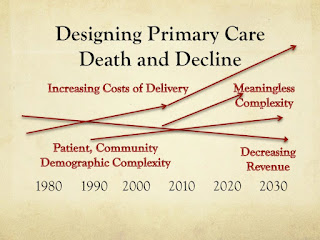
Primary care services have decreased in number steadily, year after year. Payments for primary care services overall have been stagnant as with other basic services taken for granted. Population, demand for care, and complexity are all increasing in ways that should have resulted in much more primary care for anyone who cares about primary care - but there is steadily less primary care. The financial design is broken by stagnant revenue and accelerating costs of delivery. The digital revolution has actually caused regression of primary care via worsening burnout, productivity, and meaningless complexity. The costs of delivering primary care have been increased across multiple dimensions by those who think that they are improving care when actually they are killing small health, primary care, generalists, general specialties, and basic access to care. This little death steadily, slowly over time is also specific to primary care physicians who appropriately describe it as trauma si...