Posts

Showing posts with the label Triple Threat

The Glut of Health Workforce Exposed But Ignored

When you spend a decade or more preparing and training for a career as a physician or as a nurse practitioner, you expect that you life will improve with your new employment. This is no longer a reliable expectation. Decades of overproduction of NP, PA, DO, and MD graduates will have consequences for graduates as well as for our nation. High debt from tuition, higher cost of living, the challenges of becoming a young health professional, and the difficulties dealing with employers that hold all the cards - will collaborate for worsening outcomes. The burnout, turnover, productivity, and suicide issues will intensify. Slowing Population Growth Magnifies Overproduction The new census figures indicate a slowing of population growth. This translates to a glut of health care workforce even worse than previously projected. Previous calculations of expansions used 0.72% as the annual growth rate from older census data. The newer figures are 0.62%. The decline will continue to 0.6% or ...
The Deep Squeeze Financial Design Killing Health Access

Image
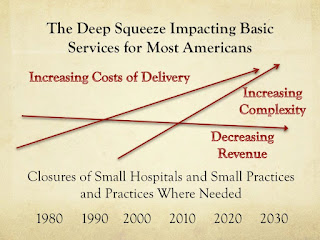
As an academic family physician specializing in basic health access, I worked to resolve shortages and improve access to care. It was my privilege to work in some of the few remaining schools devoted to such efforts. Sadly this professor found that he was learning impaired - or perhaps I was indoctrinated by the process of medical education. The financial design was far too powerful to allow training design to address deficits. What appeared to work in the 1965 to 1980 period of time, worked because of the financial design. Each year more dollars were pumped into basic services - especially where poor Americans and seniors were found. As it turns out, these are the areas with the most deficits. Initially the original Medicare and Medicaid designs helped, but they were changed into vehicles to concentrate dollars - not distribute care. The same designers continue to shape the designs into more for few and fewer for more - and basic health access suffers most by design. My solo rural...

Training Cannot Overcome Deficits By Financial Design

Image
I loved my career in rural medical education. Only rural practice was better. As a rural medical educator I felt very comfortable with the fact that there were many ways to improve the preparation for rural practice. Over time I grew uncomfortable as I recognized more and more that training was not going to overcome workforce deficits. The sad fact is that special training works for those associated with special training. Special training does not reduce the problem of inadequate access to care. The proof is in the concentrations of primary care where needed. These concentrations of primary care have remained the same - about half enough. Yes it is true that a special training program or school can have higher proportions serving in locations of need - but their success only results in displacement of others - FM for what was IM, and NP/PA for previous IM or FM. The specially trained replace the traditionally trained. This is a rearrangement of the deck chairs rather than an increas...

Focus on Supportive Designs to Fix Burnout

Image
While promoting the new well-being efforts at AAFP, the promotional material indicates what AAFP must address to result in improvements in well being for family physicians. "To function at your best in an ineffective system" would first of all require AAFP to lead the nation to address the ineffective system. Top on the AAFP list should be all resources focused upon the grossly insufficient investment in primary care. Also high on the list should be efforts to address insufficient investments in people, families, and communities for best health outcome results. Attending a conference may not work out for well-being as those who attend will return to an ineffective system.  The following critique is directed at the latest AAFP efforts to address family physician well being by web sites, live chats, and well being conferences. I learned during my time as an AMA Delegate that association activities were often turned into parties for those most associated with the ...

Surviving the Pessimists and Optimists to Deliver Real Health Care

Image
Pessimists include politicians, micromanagers, insurance payers - those that devalue those who deliver the health care or any that try to hold them accountable. Optimists sit at home optimizing care on spreadsheets and have difficulty separating assumption from reality but that does not stop their abusive policies and regulations. Realists are those out there delivering care, constantly adjusting in one on one interactions with patients as always, but they must now adjust to the resource deficits from the pessimists and to the innovative regulatory distractions of the optimists. For us realists, health care is our life. And we are tired of the abuses of the pessimists and the optimists. Let our people and our patients go.   Via Timeline Photos   Triple Threat is the enemy of health access.  Pessimistic revenue kept too low.  Optimistic tinkering accelerating costs of delivery.  Challenging patient complexity made worse b...

Sinking Health Care Design After Design

Image
Those shaping health care have long deserted the top priority focus upon health care delivery. Their efforts from above make it much harder for those delivering care down below. Those delivering care are forced to bail out health care delivery - working harder and harder to keep US health care delivery afloat despite greater challenges from above and from outside of the boat. They are too busy and are too poorly organized to address those largest, most organized, and most distant from health care delivery who continue to shape designs that fit those at the top best while leaving the rest behind.   The designers have created more lines of revenue for health care in highest concentrations (training, schools, foundations, research related corporations, management groups). The designers send the highest payments in each line of revenue to highest concentration settings. The designers are selected by a process that involves highest concentration and most exclusive origins, schools...